1
UNLOAD
2 min · lights on
Two lists, on paper: Tomorrow (what needs doing) and The Shelf (each worry, and when you'll handle it). Then lights off.
Put your head on the pillow and sleep like a rock — even when your mind won't stop.
Get the Protocol — $37Instant download. Read it tonight.
How many times have you said that this month? To your partner. To your friend. Maybe just to yourself — at 2 in the morning.
If any of this is your night
None of this makes you broken. It makes you someone whose alarm system never got the message that the day was over.
An armed alarm in a dark, silent room does what alarms do: it scans for threats. No traffic to watch, no emails to answer? Fine. It'll scan the archive. Tuesday's conversation. The bill. The thing you said in 2019.
Your brain isn't torturing you — it's doing its job with the only material available. The thoughts didn't keep the alarm on. The alarm went looking for the thoughts.
Think of it like a smoke detector set too sensitive. It's supposed to go off for fire. But after a long, stressful day, it's going off for toast.
This is why “just stop thinking about it” has never once worked — for you, or for anyone in the history of beds.
The melatonin. The chamomile tea. The magnesium — probably two kinds. The meditation app you paid for and opened four times. Maybe a tracker on your wrist right now, cheerfully scoring your failure every morning.
All of it aims at the wrong target. Those products treat sleep like it's missing. But look at your nights: sleepiness was never the problem. You're drowning in sleepiness. Eyes burning, body like sand — and still awake.
More sleepiness doesn't fix an alarm that won't disarm.
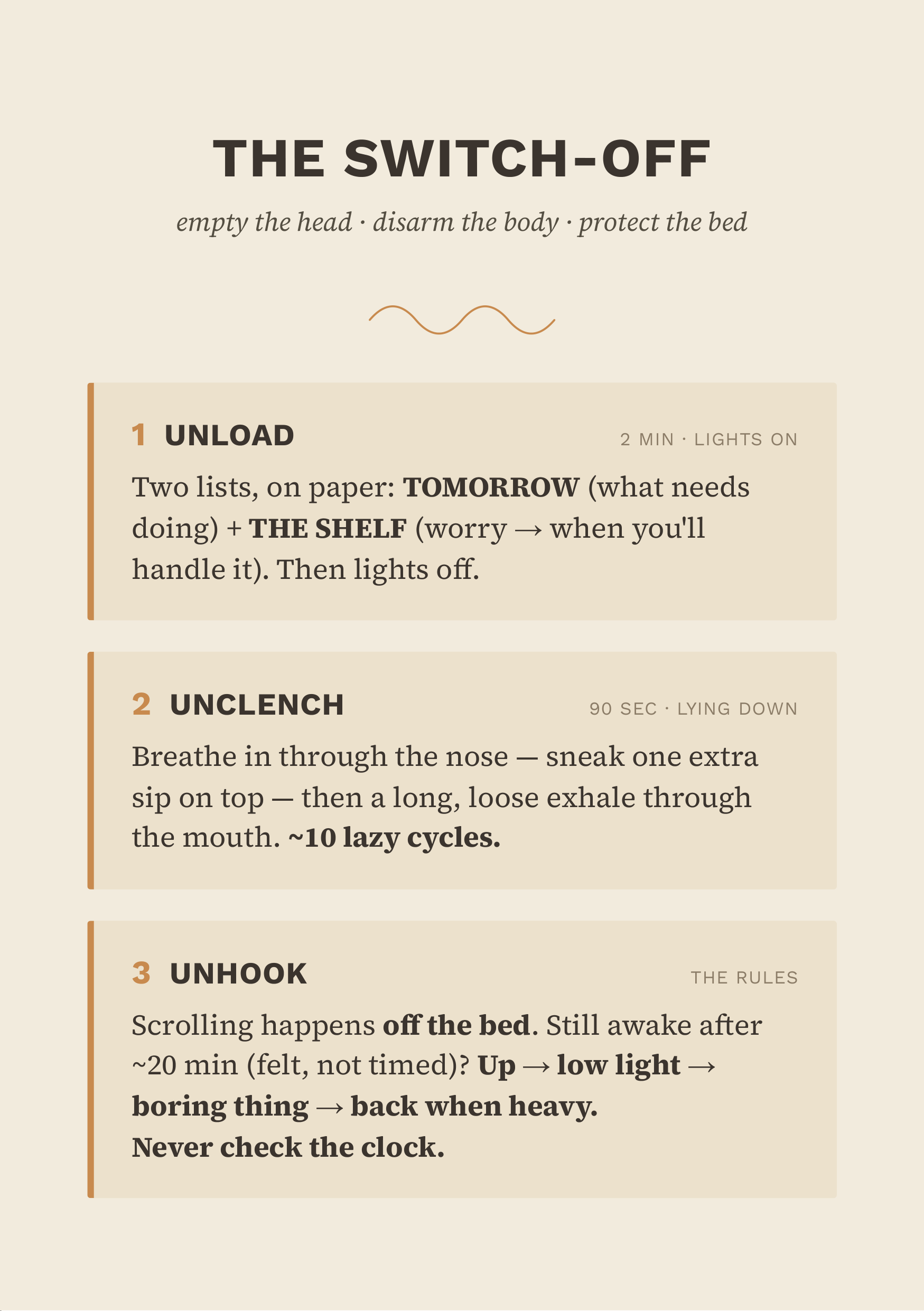
Empty the head, disarm the body, protect the bed.
Two lists, on paper: Tomorrow (what needs doing) and The Shelf (each worry, and when you'll handle it). Then lights off.
Breathe in through the nose — sneak one extra sip on top — then a long, loose exhale through the mouth. About ten lazy cycles.
Scrolling happens off the bed. Still awake after ~20 minutes (felt, not timed)? Up → low light → boring thing → back when heavy. Never check the clock.
Notice what this never asks of you: it never asks you to resist the phone. Scroll all you want — just not lying in bed. That two-meter distance changes everything.

For almost two years, I was the most exhausted awake person I knew. I'd lie down dead tired and lie there, wired, until 2 or 3 in the morning — phone in hand, hating myself a little more with every scroll.
I tried everything the internet sells. What finally worked wasn't a pill or a gadget. It was understanding why my body refused to switch off — and learning the three moves that switch it off on purpose.
Ava Benetauthor of The Switch-Off Protocol
From memory, with your eyes half closed. The book is seven short chapters — read it in one sitting, before bed. No modules, no lessons, no app to open.
The 7-Night Reset walks you through the first week, night by night — including the night it wobbles, so the wobble doesn't scare you. By the end, lying down starts to trigger drowsiness instead of dread. After the seven, the protocol is yours. It doesn't wear out.
No tracking. No scoring. No routine to maintain. Just a card by your lamp you'll barely need to glance at after the first week.
Not a sleep course. Not a 14-step routine.
One-time. No subscription. No app to keep open. No streak to maintain. Nothing to charge overnight.
Get the Protocol — $37Instant download. Read it tonight.
One honest note: this is training, not a sedative. The first night or two might be clumsy. By night three or four, the moves start running themselves.